
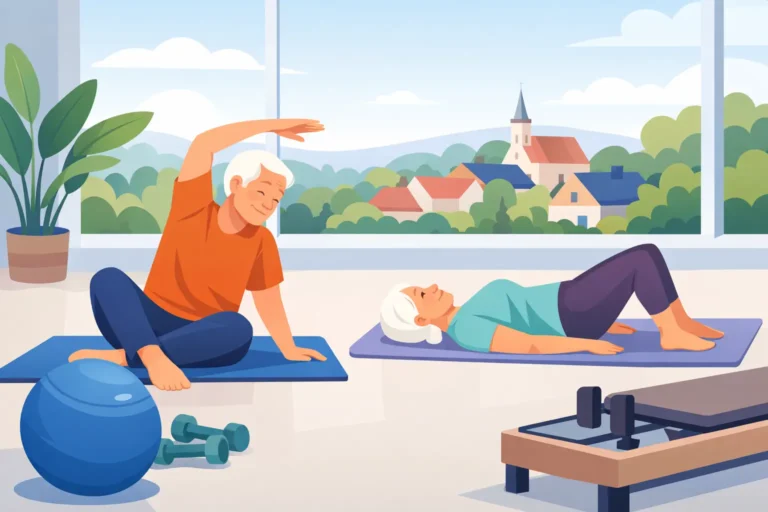
The slogan "Pilates for seniors in Józefów" often conceals a very specific need: to get back into movement without fear of worsening back, knee, or shoulder pain after class. Well-executed Pilates isn't about performing difficult movements. It's about calm, precise work on strength, balance, and freedom of movement – at a pace that's tailored to your current fitness level.
For many people over 60, the most important effect isn't the number of calories burned. It's the ability to get up from a chair more easily, to walk up the stairs more confidently, to feel less back strain, and to feel like your body is cooperating in everyday situations again. This is where smart training should begin.
Why is Pilates good for seniors?
With age, muscle mass, range of motion in joints, and the speed of response to loss of balance naturally decline. This doesn't mean you have to give up on activity. On the contrary, regular, sensible exercise helps you maintain independence and quality of life for longer.
Pilates combines strengthening with mobility. Exercises teach pelvic stability, core muscle activation, and calm breathing. We don't focus solely on one body part. The goal is to improve the coordination of the core, hips, shoulder blades, and legs, as this is crucial for walking, bending, and carrying groceries.
In practice, seniors most often notice improved posture, greater confidence in movement, and better body control. Results don't always appear after a single session, but regularity can significantly improve daily functioning.
Pilates for seniors in Józefów on the reformer
The reformer is a device with a moving platform, springs, and adjustable support points. It sounds technical, but its operation is very practical: it allows you to adjust the resistance to the user's abilities and facilitates movement within a controlled range.
Springs can gently support movement or provide greater resistance. This allows someone who isn't comfortable exercising on a mat to work in a more stable position—lying down, sitting, or resting their hands or feet on the platform. The trainer also has a good opportunity to observe. body positioning and correcting technique on an ongoing basis.
This doesn't mean that a reformer is automatically the best solution for everyone. Some limitations will require very careful modification of exercises, and sometimes simple functional movements are a better start. The advantage of a reformer is the ability to progress precisely without the pressure to immediately do more or faster.
What does a safe first training session look like?
The first session isn't a fitness test. It's a good time to tell your trainer about any previous injuries, surgeries, chronic pain, osteoporosis, joint replacements, or balance issues. Such information doesn't preclude your training—it helps tailor it responsibly.
At the beginning it is important to know the breathing, the neutral position of the spine and safe range of motion. Exercises are performed more slowly than in typical fitness classes, and instructions should be clear and specific. Instead of "stronger," it's more important to say things like "keep your core stable," "don't raise your shoulders," or "stop before pain.".
A good session for seniors includes both a strengthening and mobilizing component. It can include foot and calf work, hip exercises, shoulder blade control, gentle spine movements, and balance exercises. All of this should be done without abrupt changes in position and without comparing yourself to other participants.
Pain during exercise – what is normal and what is a stop sign?
Light muscle movement, a feeling of exertion, or gentle stretching can be a natural part of training. Sharp, stabbing pain, numbness, dizziness, shortness of breath, or increasing joint discomfort are not something to be "started." In such a situation, the exercise should be stopped and reported to the trainer immediately.
People with diagnosed osteoporosis, uncontrolled hypertension, heart disease, recent injuries, or recent surgeries require special attention. In such circumstances, it's best to consult a doctor or physiotherapist before starting an activity. Pilates can provide valuable support for fitness, but it doesn't replace diagnostics or rehabilitation for specific health issues.
A small group provides greater comfort and better technique
In senior training, the quality of the training is more important than the pace of the session. A small group allows the trainer to notice whether the knee isn't rolling inward, whether the shoulders aren't taking over the back, and whether the movement is truly comfortable. These are details that help build fitness without unnecessary strain.
At Velvet Gym, Pilates Reformer classes for seniors combine modern equipment with expert coaching focused on technique and individualized resistance adjustments. It's not about breaking records. The point is to leave your workout feeling good about having accomplished your goal, not fearing soreness the next day.
For some people, a quiet environment is also important. The lack of crowds, clear instructions, and a consistent class structure make it easier to get started, especially if you've been away from exercise for several years. Mental comfort isn't just a bonus—it often determines whether you stick with it for the long haul.
How often should you exercise to notice a change?
Usually this is enough to get started two training sessions a week. This frequency gives the body time to adapt while also building a habit. After a few weeks, you can assess how your muscles, joints, and energy levels are responding.
On rest days, it's worth adding a leisurely walk, a few minutes of mobilization, or simple exercises recommended by a trainer. The best plan doesn't have to be intense. It should be realistic and sustainable for months. One regular session per week will be more beneficial than an ambitious plan that ends after two weeks.
What to wear and how to prepare for classes?
All you need is comfortable clothing that doesn't restrict movement and non-slip socks. There's no need for a strenuous warm-up before your workout, but it's worth arriving a few minutes early, drinking water, and calmly chatting with your trainer about how you're feeling that day.
If you experience unusual stiffness, pain after a fall, or weakness this morning, don't hide it for the sake of consistency. Sometimes a change in range of motion or position is enough, and sometimes it's more sensible to postpone your workout. Responsible movement isn't about abandoning your goal, but about adapting your path to your current abilities.
The best time to start Pilates isn't when your form is "perfect." It's when you want to move more easily, stand more confidently, and take care of yourself with a workout that respects your pace.