
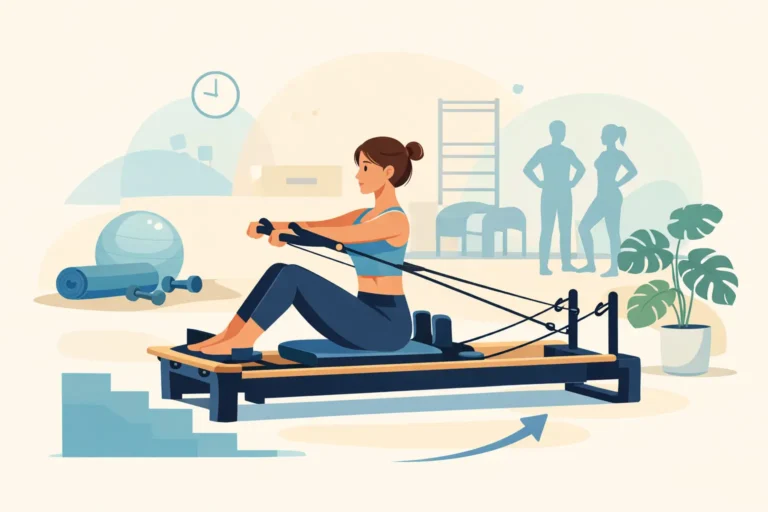
The first experience with a reformer often looks like this: you see a machine with springs, a moving platform, and straps, and then you wonder if this is really a workout for someone inexperienced. The good news is that Pilates reformer for beginners really makes sense—provided you start under the guidance of a trainer, with a well-chosen difficulty level, and an emphasis on technique rather than pace.
This isn't just for the very fit, dancers, or fitness enthusiasts. The reformer is also great for strengthening your core after long hours at a desk, improving your posture, relieve the spine and start exercising smarter, without the chaos of a crowded gym.
What exactly is a reformer and why beginners can handle it
The reformer is a Pilates training device that utilizes spring resistance, platform movement, and various positions—lying, sitting, kneeling, and standing. In practice, this allows for a great deal of control over movement. You're not exercising haphazardly. Every position matters, and each exercise can be made simpler or more challenging.
This is why beginners often feel safer on the reformer than during traditional fitness classes. You have a clearly defined path of movement, it's easier to maintain concentration, and it's easier to understand which muscles need to be worked. This is especially important when you want to strengthen your core, improve stability, and rebuild good movement quality.
This doesn't mean, however, that the reformer is easy. It's precise. And that's a big difference. The training can be demanding, even if it looks calm from the outside. You work deeply, precisely, and often slower than you're used to.
Pilates reformer for beginners - what to expect during your first class
The first workout isn't about impressive figures or perfectly executing every sequence. The goal is to learn the equipment, breathing, and basic body positioning. The trainer typically demonstrates how to get on the reformer, how to position your feet, hands, shoulders, and pelvis, and how to safely work the springs.
The beginning can be surprising, because the exercises look innocent, yet you quickly feel the muscles in your abs, glutes, back, and inner thighs. This is normal. The reformer doesn't build its effect through accidental fatigue, but through precision. If the movement is well-executed, the body receives a very specific stimulus.
You may also notice that one side works differently than the other. This is valuable information, not a reason for frustration. Many people, even after their first workout, experience limited mobility, poorer stability, or a habit of overloading the lumbar spine. This is precisely why this type of training produces such positive results – it teaches the body to function more evenly and consciously.
Do you need to be fit or flexible?
No. This is one of the most common myths. You don't have to be flexible or athletic to start. Flexibility, strength, and control come with time. More important than starting out in shape is whether you're training in a place that can tailor the classes to your abilities.
If you're returning to exercise after a long break, have a sedentary job, or feel tension in your neck and back, the reformer may be a sensible start. Of course, in some situations—for example, with recent injuries, acute pain, or after surgery—it's worth consulting a specialist first.
What the reformer gives the results at the beginning
The most noticeable initial effects aren't always related to posture, although that too begins to change. Many people initially notice better standing, easier to maintain an upright posture, and less tension in their lower back. They also develop better abdominal control and a greater awareness of how to move daily without straining the spine.
Over time, strength, stability, and fluidity of movement improve. The body becomes more flexible, lean, and agile. This is important because Pilates on the reformer isn't just about burning calories. Its significant value lies in improving the quality of movement, which translates to both appearance and well-being.
If you only count on quick reduction of centimeters, it's worth approaching the topic realistically. The reformer provides excellent support for the physique, but the best results occur when training is regular and combined with daily movement and meaningful recovery.
The most common fears before the first training session
Many people worry about not keeping up with the group or feeling awkward around the equipment. This is understandable, especially if you've previously trained mostly at home or not at all. However, well-run beginner classes are structured to allow time for learning the setup and understanding the movements.
The second common concern is pain. It's important to distinguish between exertion and overuse. Training can be intense, and you might feel muscles working and a slight tremor during more challenging exercises, but acute pain in the joints, neck, or spine is not something to ignore. A good trainer will react immediately, adjusting the positioning or choosing a simpler version of the exercise.
There's also the question of age. And rightly so, because not every workout is suitable for every stage of life. The reformer has the advantage of being highly scalable. Therefore, it's used by both young people and those who want to return to safe exercise after years of inactivity.
How to choose good classes when you're just starting out
At the beginning, it's not just the equipment itself that matters, but the way the class is conducted. Look for a place where the trainer genuinely corrects technique and the group size isn't too large. With the reformer, details matter – the positioning of the pelvis, ribs, shoulders, breathing, and feet all impact the overall effect of the workout.
It's worth noting whether classes are described as introductory or for beginners. If a studio offers small groups and individualized training, that's a big plus. In a more premium approach, technology and movement monitoring can further enhance precision, but the trainer's experience and attentiveness are still paramount.
For those from Józefów, Otwock, Falenica, or Karczew, convenient access is also practical. Regularity creates results, so it's best to choose a place you'll actually return to, not just admire on Instagram.
What to wear and how to prepare for your first visit
Comfortable, fitted clothing that doesn't restrict movement is best. Non-slip socks are also helpful, as they increase comfort and safety on the equipment. No special fitness level or Pilates knowledge is required.
It's worth arriving a few minutes early and telling the trainer about any pain, injuries, and training experiences. The more information you have at the beginning, the easier it is to tailor your exercises. This isn't a scolding of your own body. It's a sensible starting point.
How many times a week should you exercise to see a difference?
If you're just starting out, two workouts a week is a great rhythm. It allows you to master the technique, give your body time to adapt, and quickly see the first results. One session a week also makes sense, especially with a busy schedule, but progress will be slower.
Three workouts a week work well for people who recover well and truly enjoy this way of working. More isn't always better. Initially, what matters more than frequency is whether you're training thoroughly and regularly.
If you're also looking to build greater strength or improve your fitness, the reformer can be a great base, but sometimes it's worth combining it with another form of exercise. This combination often yields the best results – improved technique, a stronger core, and greater efficiency in everyday movement.
Why starting on a reformer can be a breakthrough
For many people, the first few weeks on the reformer are the moment when training ceases to be a punishment for a sedentary lifestyle and begins to act as a real support for the body. Suddenly, it becomes clear that you can exercise without chaos, with a sense of control, and with a clear impact on how you sit, walk, and function for the rest of the day.
That's why Pilates reformer for beginners so often becomes the beginning of lasting change. It doesn't promise miracles after a single workout. It offers something more valuable – a safe, effective start and the feeling that your body can perform better than you previously thought.
If you feel like you need movement that is both strengthening, relieving, and teaching good patterns, the reformer is a very good place to start, calmly but specifically.