
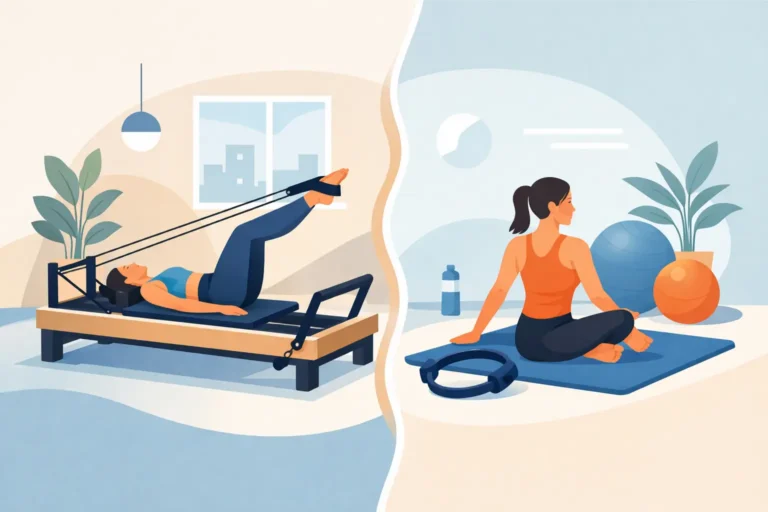
Not every form of Pilates provides the same feeling after the first class. One person leaves the mat with a pleasant feeling of core muscle work, while another only feels a genuine understanding of the alignment of the pelvis, shoulders, and spine on the reformer. If you're wondering whether to choose a reformer or a Pilates mat, the answer is: it depends on your goals, your fitness level, and what support your body needs today.
Reformer or Pilates mat – what determines the choice?
At first glance, the difference seems simple. A mat is for bodyweight exercises, while a reformer is a specialized machine with springs, a platform, and straps. In practice, however, it's about more than just the equipment. It's about the quality of the movement, the level of control, and how easy it is to maintain good technique throughout the entire class.
The Pilates mat develops body awareness in a very pure form. There's no additional support, so you primarily work with your own stability, breathing, and precision. It's a great foundation, but for some people, it can be more demanding than it seems. This is especially true when you experience tension in the lumbar spine, a weakened core, or difficulty maintaining a neutral spine position.
The reformer works differently. The springs provide resistance, but also help guide the movement. This makes it easier to feel which muscles should be working and to what extent. For many people, Pilates becomes more understandable on the reformer, and the body begins to move better, faster, not just more intensely.
What does Pilates on the mat do?
The mat has one major advantage – it teaches self-control. Without a moving platform and additional guidance, you need to more consciously position your ribs, pelvis, shoulder blades, and head. This develops coordination and core stability, the foundation for a healthy spine and efficient daily movement.
Well-conducted Pilates on the mat can be very effective in strengthening deep muscles, improve mobility, and slim your figure. It also works well as a complement to other activities, from strength training to running. It's also convenient to organize – it's easy to continue at home.
It's worth being honest, however, that the mat isn't always the easiest place to start. Beginners often try to compensate for technique by tightening their neck, shoulders, or lower back. If the instructions are too general or the group too large, it's easy to reinforce the wrong pattern.
What does Pilates Reformer offer?
The reformer provides a highly precise environment for learning movement. The platform moves along a track, springs provide the required resistance, and the exercises can be tailored to your level of advancement and current abilities. This means that the exercises can be safe, effective, and truly enjoyable.
For people who want improve posture, To relieve the spine and strengthen the body without overloading the joints, the reformer can be a great solution. The movement is smooth, controlled, and easier for the nervous system to understand. It's also easier to work on symmetry, range of motion, and stability, because any compensations become apparent more quickly.
It's also a great tool for body shaping. The springs allow for progression without aggressively overloading the body. Muscles work long hours, precisely, and with complete focus. The result is not only a firmer body but also improved movement quality outside the gym – when walking, sitting, bending, or lifting groceries.
Reformer or Pilates Mat for Back Pain
If your main goal is relief for the spine, the question of reformer or Pilates mat becomes especially important. Back pain isn't just about movement, but about the right movement.
A mat can work very well if the exercises are tailored to the problem and technique is constantly adjusted. This is especially important for those with a weakened abdominal wall, excessive anterior pelvic tilt, a stiff chest, or strain from a sedentary lifestyle. The problem occurs when the body doesn't yet have sufficient control to maintain a good posture without support.
This is why many people with back problems find it easier to use a reformer. The springs relieve pressure where needed and provide resistance where strength is needed. You can more safely work on lengthening your spine, stabilizing your pelvis, and activating your core. This is especially valuable at the beginning of your journey, when your body needs not only training but also a clear signal about how to move.
What slims the figure better?
This is one of the most common questions, and again, the answer isn't a binary one. Both the mat and the reformer help you build a lean, toned physique. The difference lies in how quickly you feel the results and what type of stimulus your body needs.
The mat strongly engages stabilization and isometric work. It provides excellent control, improves body alignment, and teaches elegance of movement. The reformer, on the other hand, allows you to more easily increase intensity without sacrificing technique. This is important if you want not only subtle strengthening but also more noticeable toning of your legs, glutes, abs, and back.
In practice, the best aesthetic results are achieved by combining both forms. The mat builds a base and awareness, while the reformer adds precise resistance and a greater variety of stimuli. This combination effectively supports both posture and a healthy movement pattern.
Who is a checkmate and who is a reformer?
If you like simplicity, want to learn breathwork, and want to practice regularly at home, a mat can be a great choice. It also works well for those who already have basic body control and can maintain technique without additional guidance.
The reformer is often chosen by beginners, those returning to exercise after a break, those experiencing back tension, or those looking for an effective yet gentle workout. It's also a good option if you value training in a private setting, precise guidance from a trainer, and greater personalization of exercises.
Clubs that prioritize movement quality are increasingly choosing one over the other. They combine reformer training with mat work, sometimes with elements of barre or functional training. This approach makes sense because the body doesn't operate in compartments. It needs stability, mobility, strength, and control.
When the reformer is no better than the mat
It's worth stating this clearly – the reformer isn't a magic shortcut. Anyone who relies solely on the machine to do the work for them will quickly be disappointed. Pilates Reformer requires focus, precision, and a willingness to pay attention to detail. Without these, it's difficult to achieve real results.
Some people also appreciate the mat more over time, as it gives them a greater sense of independence and makes it easier to translate into everyday movement. This is common among those who already have good technique and want to develop control without additional tools.
It's best to view both forms not as competition, but as two different ways to build a fit, strong body. One doesn't exclude the other.
How to get started if you're not sure
If you're just starting out and don't know what to choose, choose something that will give you the best technique from the very first session. This is more important than a fad or the passing popularity of a particular form. A well-conducted workout should help you feel your body better, not just tire yourself out.
For those with tension, a sedentary lifestyle, weakened core muscles, or fear of back pain, the reformer often proves to be a more comfortable starting point. With good body awareness and a willingness to practice regularly outside of the gym, the mat can be just as valuable. In modern studios like Velvet Gym, a mixed approach works best – the trainer tailors the workout to the individual, not the other way around.
The body quickly reveals what it needs. If, after a workout, you feel longer, stronger, lighter in your back, and more confident in your movements, you're on the right track. Pilates isn't about choosing the most effective option, but about training that genuinely improves your quality of life.