
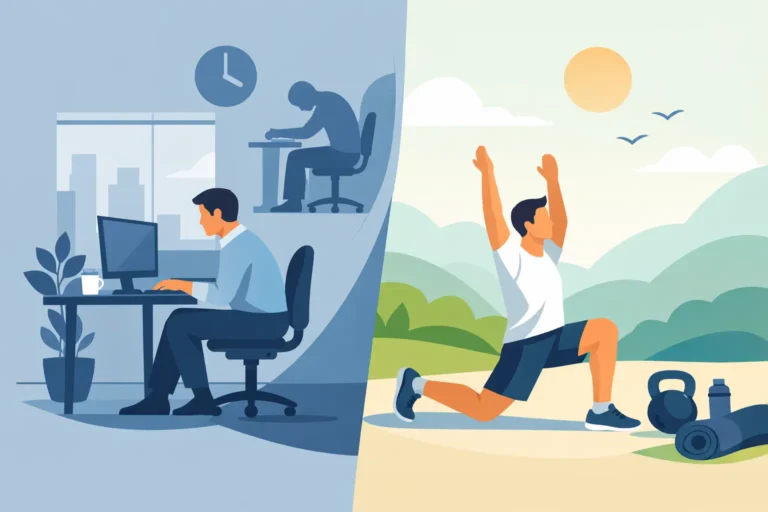
At 5:00 PM, your body often tells you something completely different than your head. You mentally want to "get a good workout," but your hips are stiff, your thoracic spine is practically immobile, and your neck still remembers eight hours spent on a laptop. That's why a safe workout after a sedentary job doesn't start with intensity, but with restoring your body's range of motion, breathing, and control.
This is an important difference, because after a long day of sitting, the body isn't simply "tired." It's placed in a specific position: with contracted hip flexors, weakened glutes, tense shoulders, and less ready for dynamic movements. If you jump straight into quick squats, running, or heavy strength training, it's easy to overwork areas that are already overworked. A good post-workout workout is meant to restore balance, and only then build fitness.
Why the body needs a different start after sitting
A sedentary lifestyle doesn't have to be a problem in itself. The problem begins when you repeat a single position for hours and then expect your body to perform at full capacity without any preparation. The spine, hips, and shoulder girdle don't appreciate this sudden shift from stillness to high load.
You'll most often experience this as lower back pain, a "pulling" in your neck, stiffness in the back of your thighs, or a feeling that your form is quickly falling apart during exercise. This doesn't always indicate a lack of form. Often, it simply means your body needs a better input into the movement.
A safe workout after a sedentary job should therefore consider three things: mobility, activation, and gradual effort. This approach is more effective than jumping straight into heavy weights or intense intervals. Importantly, it also produces better physique and health benefits, because correct technique allows you to truly focus on the right areas.
Safe training after a sedentary job – where to start
The first 8-12 minutes are crucial. They're not "extras," but rather part of the workout that determines whether the movement will support your spine and joints or irritate them.
A gentle start to the exercise is a good way to activate your breathing and chest. A few deep breaths followed by a prolonged exhale help reduce tension and improve core control. Then, it's worth moving on to mobilizing the thoracic spine, shoulders, and hips. This isn't about aggressive stretching, but rather restoring fluidity.
The next step is to activate the muscles that often "sleep" after sitting: the glutes, deep abdominal muscles, and shoulder blade stabilizers. Short, precise exercises performed consciously work better here than a chaotic warm-up. Once the body begins to cooperate again, you can move into the main part of the workout.
What forms of exercise work best after office work?
It depends on your goal, your fitness level, and whether you already have pain. Not everyone needs the same thing after a sedentary day. However, there are forms of exercise that usually work better than random, high-intensity exercise.
Pilates, especially on the reformer, is a good choice when you want to improve posture, mobility, and movement control without overloading your spine. This type of training teaches pelvic alignment, core strength, and smooth muscle engagement. This is especially valuable if you sit a lot and feel like your body is "glued together.".
Strength and functional training It also makes perfect sense, but only if it's done well. Quality is better than random volume after work. Squats, deadlifts, lunges, pulling movements, and pressing movements are valuable if the load is matched to your current readiness and your technique remains consistent from the first to the last rep.
Gentle cardio, such as uphill walking on a treadmill, cycling at a moderate pace, or using an ergometer without getting out of breath, can be a good option for those who are very tense and overworked. It's not always necessary to "finish off" with intervals. Sometimes, a workout that leaves you feeling better afterward than before you entered the gym can have a better effect on your physique, recovery, and nervous system.
What not to do immediately after 8 hours of sitting
The most common mistake is starting with exercises that require a large range of motion and high control when the body is not yet ready. This is especially true for dynamic jumps, sprints, heavy "cold" squats, and intense crunches performed with a tense neck and poor stabilization.
The second mistake is ignoring pain. Muscle discomfort is one thing, but a stabbing pain in the spine, radiating down the leg, numbness, or shoulder pain every time you lift your arm are warning signs that shouldn't be ignored. In such situations, training should be modified, or sometimes even temporarily halted.
The third mistake is copying the plan of someone who has a completely different body and a completely different day. Someone who works physically will have different needs than someone who spends nine hours at a desk. A good plan takes into account lifestyle, not just training goals.
What a reasonable weekly plan should look like
If you work primarily in a sedentary setting, a rhythm that combines strength training with sessions that improve mobility and movement quality often works best. Two or three strength and functional training sessions per week are very effective, as long as there's room for recovery in between. It's also worth adding one or two more gentle sessions that focus on core, breathing, stabilization, and range of motion.
This solution is usually more effective than five random, intense workouts. After a sedentary job, the body often doesn't need more stimuli, just better stimulus selection. In practice, this means less chaos and more precision.
If you're a beginner, start with two regular workouts a week and add a few minutes of exercise outside the gym each day. A short walk, some mobility exercises in the morning, or a break from sitting during the day can really make a difference. Training won't fix everything if the rest of the week is a constant state of inactivity.
Safe training after sedentary work and back pain
Many people come to training precisely because they have back pain. This is a good approach, but with one condition: the movement must be well-chosen. Not all back pain is the same. For one person, the problem will be stiff hips and a lack of gluteal activity, while for another, it may be lumbar strain due to poor stabilization and chest tightness.
Therefore, there's no one-size-fits-all approach. However, there are common principles. It's usually best to limit movements that exacerbate symptoms, improve pelvic and breathing control, rebuild stabilization, and gradually return to full-body strengthening. This approach yields better and more lasting results than simply "stretching the back.".
Observing technique also plays a significant role in modern training. If an exercise only looks good for the first three repetitions, and then the body begins to compensate, it's a sign that the load, range of motion, or variation needs to be changed. This is where the difference between haphazard training and truly safe training becomes most apparent.
Technology and trainer – a duo that increases safety
After a sedentary job, it's easy to miss the fact that your body is "cheating." You might be squatting, but the weight is shifting to one side. You might be strengthening your abs, but in reality, you're tightening your neck and lower back. That's why simply wanting to do something isn't always enough.
Training in which movement is visible, controlled, and corrected in real time is very helpful. Combining the guidance of a trainer with motion imaging technology It offers a specific benefit: you can spot mistakes more quickly, adjust your load more easily, and it's harder to perpetuate bad patterns. For someone working at a desk, this is especially valuable, as the goal isn't just to burn calories, but to move so your body feels and looks better.
At Velvet Gym, this approach makes sense, especially for those who want to return to training after a break, are stressed from sitting too long, or simply don't want to guess if they're exercising correctly. The intimate setting and precise guidance make it easier to focus on technique, which usually translates to faster results and a reduced risk of overtraining.
How do you know if your after-work workout is working?
It's not just about muscle soreness or the fact that you can barely walk down the stairs. A good sign is less stiffness after a few weeks, easier posture, less tension in the neck and shoulders, and greater stability in everyday movements. Energy in the evenings and sleep quality often improve as well.
Results also come in terms of physique, but usually when the body begins to work more effectively. Better technique means better muscle engagement. Better mobility means a wider range of work. Less pain means greater consistency. And consistency is still one of the most important factors if you want to see real change.
If you want to train smart after work, don't try to compensate for sitting with aggressive effort. Give your body a few minutes to get back into motion, choose training options that build strength and control, and treat technique as an investment, not a hindrance. This is when movement really starts to work for you.