
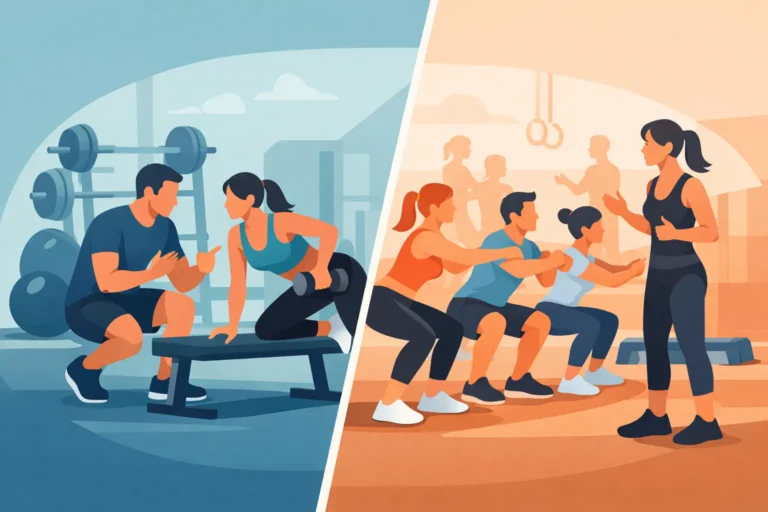
You face a choice: personal or group trainingIt's not just about how many people will be working out alongside you. It's about the pace of work, the level of support, your mental comfort, and the path you choose to a better physique, a stronger core, and a more efficient spine.
The good news is that there's no single right answer for everyone. Instead, there are specific situations where one form of training yields significantly better results than another. It's worth recognizing these before purchasing a membership or scheduling your first class.
What really distinguishes personal training from group training?
During personal training, your trainer works primarily with you. They select exercises based on your goals, current fitness level, mobility limitations, and how you're feeling that day. They can adjust the resistance on the fly, shorten the range of motion, suggest an easier variation, or guide you further if they see you have strength to spare.
Group training is based on a shared rhythm of classes. It offers the energy of movement in a small group, fixed hours, and enjoyable motivation: it's easier to show up at the gym when you know a trainer and a team of other people are waiting for you. However, this doesn't mean anonymously performing movements in a crowd. In well-run small groups, the trainer still observes technique and provides corrections, although there isn't as much time for each person as in an individual session.
The difference, then, isn't whether group training is "worse." It's about the balance between individualization and the dynamics of collective action.
When will personal training be a better choice?
Individual training is most valuable when you need precision. Especially at the beginning, after a long break from activity, or when your body is sending you signals you don't want to ignore.
When you're starting out and don't know where to start
The first few weeks of training are often crucial to whether exercise becomes a regular habit. If you're apprehensive about equipment, unsure of proper squat technique, or have had a few unsuccessful attempts at returning to exercise, a personal trainer can give you a calm, safe start.
Instead of guessing how to position your feet, tighten your core, or choose the right weight, you get clear instructions. This saves time and reduces the risk of overexertion. Equally important, you'll quickly gain confidence in your ability to exercise independently.
When your goal is a specific effect
Losing weight, building strength, getting back into shape after pregnancy, preparing for a run, or improving mobility all require different training emphases. A plan that's "one size fits all" won't always be the right plan for you.
Personal training makes it easier to monitor your progress. Your trainer can record the weights, reps, range of motion, and your body's response. This ensures you're not training haphazardly. You know what you're doing, why you're doing it, and how to check if you're making progress.
When your back hurts or you have limited mobility
Pain doesn't always mean you have to stop exercising completely. It often means you should exercise smarter. tense lumbar spine, stiff hips, weakened deep muscles or knee problems, individual guidance helps to choose a safe starting point.
A trainer doesn't replace a doctor or physiotherapist, but can tailor training to the specialist's recommendations and teach movement that doesn't add further stress to the body. The priority is then quality, control, and the gradual rebuilding of confidence in one's own body.
When is it worth choosing group training?
Group classes are a great option for people who need regularity, positive energy, and proven structure. Many people exercise more effectively not because someone is monitoring them, but because the training is built into their schedule and is simply enjoyable.
Pilates Reformer In a small group, you can work on stabilization, mobility, posture, and a lean, agile physique at a mindful pace. The resistance of the springs can be adjusted to your skill level, and a trainer helps you monitor your body positioning. This is a good option for both beginners and those who want to feel more in control of their movement.
Group strength and functional training, on the other hand, is a good choice if you want to develop the strength, fitness, and agility you need for everyday life. Getting up from the floor, carrying groceries, climbing stairs, or taking a long walk all take on a completely different feel when your body is strong and stable.
Personal or group training if you care about your figure?
If your primary goal is toning your body, don't choose a workout based solely on the number of calories burned. Regularity, appropriate intensity, progression, and recovery build physique results. The best workouts are the ones you'll actually stick with for months to come.
Personal training accelerates technique learning and allows you to precisely develop the body parts you care about. It's especially helpful if you want to build glutes, strengthen your abs, improve body proportions, or learn strength training without the chaos.
Group training can be just as effective if it fits your lifestyle. Pilates Reformer improves muscle tone, posture, and body awareness. Functional training helps build strength and endurance. Combining both forms often yields excellent results: the body is stronger, more mobile, and better prepared for everyday movement.
Technology will not replace a trainer, but it can enhance the effects
Modern training solutions make sense when they help you better see movement, not just create an impression. Visually guided exercise screens make it easier to understand the sequence of exercises and the pace of work. This allows the trainer to focus more attention on things the screen doesn't fully assess: pelvic position, muscle tension, breathing, movement quality, and proper load selection.
At Velvet Gym, Nano Gym technology supports strength and functional training This is precisely how it is. It provides a clear structure, while at the same time not taking away the most important element: human observation and response to the needs of the person exercising.
Can both forms of training be combined?
You don't have to choose one path forever. For many people, the best solution is to combine group training with occasional personal training.
For example, you could regularly attend Pilates Reformer or functional classes, and use the individual session to learn technique, assess progress, or adjust your plan. This is a practical arrangement for people who value a group atmosphere but also want to ensure their movement is aligned with their goals.
This combination also works well when returning after a break. A few personal training sessions can prepare your body and mind for a stress-free group workout. Regular group classes, on the other hand, help you maintain your rhythm once you've mastered the basics.
How to make a decision without pressure?
Ask yourself three simple questions: Do I need special technique control right now? Do I find it easier to stay motivated when exercising with others? And is my goal very specific, or do I just want to move regularly and feel better?
If you need a relaxed introduction, have mobility limitations, or want a precise plan, start with personal training. If you want to incorporate activity into your week, enjoy the communal energy, and enjoy the structure of classes, choose an intimate group training session. And if you're still hesitant, treat the first session as a comfort check, not a permanent commitment.
The best decision is the one that leaves you stronger, calmer, and with the feeling that your body is being guided in the right direction. Don't look for the most difficult form of exercise. Choose one that will allow you to exercise regularly, safely, and with real satisfaction.