
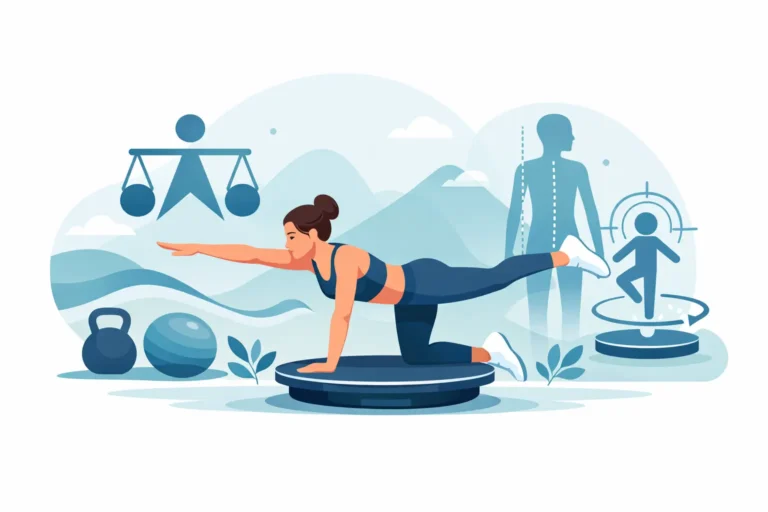
Stabilization isn't about holding a plank for as long as possible. It's about maintaining control of your body while getting up from a chair, carrying groceries, running, strength training, or lifting a child. The best exercises for stabilization They teach muscles to work together, improve posture and help relieve the spine during everyday movements.
The good news is that you don't need a complicated routine or hours spent on the mat. You need precision, a well-chosen level of difficulty, and consistency. When it comes to stabilization, quality always trumps quantity.
What does good stabilization actually mean?
A stable body isn't stiff. It can respond to changes in position, maintain a safe pelvis and spine alignment, and transfer force between the legs, torso, and arms. This is why stability training promotes both a leaner physique and greater fitness.
We most often talk about the deep abdominal muscles, but stabilization encompasses much more. It involves the diaphragm, pelvic floor muscles, glutes, back muscles, feet, and shoulder girdle. If one of these components isn't performing its role, the body usually seeks compensation. The result can be a tight neck, a strained lower back, knee pain, or a feeling that the lower back is "taking over" during exercise.
This is why stability training is so important after a long time sitting, with recurring back discomfort, after a break from activity and as a base for strength training, running or Pilates Reformer.
The Best Stabilization Exercises – 7 Moves to Start With
The following exercises can be performed 2-3 times per week. Start with an easy pace and complete 2 sets. For most movements, a range of 6-10 controlled reps per side, or 20-30 seconds of holding, will work. If your form deteriorates, end the set early.
1. 360-degree breathing with abdominal activation
Lie on your back, bend your knees, and place your feet hip-width apart. Place one hand on your chest and the other on your lower ribs. Inhale until your ribs expand out to the sides and slightly back, without lifting your shoulders. As you exhale, gently contract your lower abdomen, as if you were trying to zip up tight pants.
Don't force your lower back into the mat or pull your abs in completely. The goal is a relaxed tension that doesn't inhibit your breathing. This simple exercise teaches you how to work your diaphragm and deep core muscles, the foundation for subsequent movements.
2. Dead bug, i.e. alternating work of arms and legs
Stay on your back. Raise your legs so your knees are over your hips and your arms are straight over your shoulders. Exhale, slowly lower one leg and the opposite arm, maintaining a neutral spine. Return to center and switch sides.
The most important thing is to keep your pelvis from tilting and your ribs from sagging upward. If you feel tension in your lower back, shorten your range of motion or move only your leg. The dead bug is great for building control, which is essential for walking, running, and weight-bearing exercises.
3. Hip Bridge with Pelvic Control
Lying on your back, place your feet under your knees. Exhale, engage your abs slightly, and lift your hips, pressing your feet into the floor. Pause when your torso and thighs form a straight line, then slowly return to the mat.
The hip bridge engages the glutes, which are crucial for stabilizing the pelvis and knees. Don't lift your hips so high that the weight shifts to the lower back. If the exercise is easy, hold the position for 3 seconds at the top or perform a variation where you slowly lift one foot, but only with full pelvic control.
4. Bird dog at a slow pace
Get on your knees, supported by your hands under your shoulders, your knees under your hips, and your gaze downward. Extend one leg back and the opposite arm in front of you simultaneously. Don't twist your hips or lift your leg higher than your torso.
Bird dog demonstrates your ability to maintain stability while your limbs move. Imagine a glass of water resting on your lower back, and you don't want to spill it. This is a better guide than trying to stretch your arm and leg as far as possible.
5. Side plank on knee or feet
Lie on your side and rest your forearm under your shoulder. For an easier version, bend your knees and then lift your hips, creating a line from your head to your knees. For a more challenging version, rest on the outer edges of your feet.
This exercise strengthens the lateral wall of the torso and the muscles responsible for pelvic stabilization. Avoid sinking in at the shoulders or pushing your hips too far forward. Start with short, well-controlled holds – 15 seconds of precise execution will yield more than a minute of struggling with the technique.
6. Pallof press with resistance band
Stand sideways to the band's attachment point, grasp it with both hands at breastbone level, and step back so the band is taut. Place your feet firmly, bend your knees slightly, then push your hands out in front of you and return. Your torso should remain stationary despite the force trying to rotate your body.
The Pallof press is a very practical anti-rotation movement. It teaches the control needed for side-carrying, twisting, and functional training. Start with light resistance. Too tight a band can quickly turn a stabilization exercise into uncontrolled jerking.
7. Reverse lunge with pause
Stand up straight, transfer your weight to one leg, and slowly step back with the other leg. Lower to a comfortable range, pause for a second, and then return to standing. Bring the knee of your supporting leg toward your second toe without collapsing inward.
The reverse lunge combines foot, knee, hip, and core stabilization. It's especially valuable because it prepares you for everyday single-leg situations—climbing stairs, bending, or faster walking. If you lose your balance, hold on to a wall or railing. This is a sensible progression, not a shortcut.
How not to lose results due to technical errors?
The most common mistake is treating stabilization as a test of endurance. When you experience full-body tremors, breath holding, and neck tension, your body is likely no longer performing as you expect. Reduce the difficulty, shorten the set, or reduce the range of motion.
The second problem is excessive abdominal bracing. Stabilization is meant to support the movement, not turn it into apnea. Maintain a relaxed breathing pattern throughout each exercise. Exhaling during the more challenging phase usually helps maintain tension without overloading the neck and shoulders.
It's also worth remembering that mat exercises alone won't solve all problems. If you spend eight hours in one position and then do an intense workout once a week, your body will still need more movement throughout the day. Short walks, changing your position at work, and consciously getting up from a chair are all part of the same puzzle.
When to choose Pilates and when to choose functional training?
Pilates Reformer It's a great option for rebuilding movement control, improving mobility, and working on stabilization within safe, precise ranges. The device's springs allow you to both reduce the load on your movements and gradually increase resistance. It's a good choice for beginners, those returning to exercise, and those seeking a healthy spine and improved posture.
Functional training is especially useful when you want to translate stabilization into strength, dynamic movements, and everyday fitness. Squats, lunges, unilateral exercises, and weight training teach the body control in more demanding conditions. A combination of both approaches usually yields the best results—first learning the quality of movement and then strengthening it through practice.
At Velvet Gym, the trainer and visual guidance help you notice details that are difficult to spot on your own: pelvic position, knee path, and shoulder tension. This makes training not a random series of exercises, but a process tailored to your level.
When is caution needed?
If your back pain radiates down your leg, you experience numbness, weakness, dizziness, or the pain worsens despite rest, first consult your doctor or physical therapist. After an injury, surgery, during pregnancy, and in the postpartum period, it's also important to tailor your exercise plan individually.
Stabilization doesn't have to start with difficult poses. Sometimes the biggest change comes from calm breathing, a properly performed hip bridge, and a few weeks of regular practice. The body quickly appreciates movement that's performed mindfully, painlessly, and with the intention of making each day easier for you.